4. How our senses affect our eating
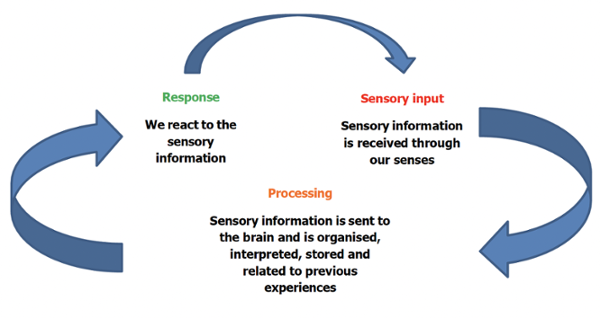
- The body receives information through the senses and the world around us.
- The information is sent to the brain
- The brain tries to work out what the information is
- The brain sends a message to respond to the information
When sensory information is processed correctly, we can then complete all our daily activities efficiently without much thought.
We use this information in many ways – to help us understand our body, understand the environment and successfully interact with the world.
How the senses impact on feeding sight
Our sight helps us to focus on what we need to and respond appropriately. It helps us to locate and follow objects.
How our sight can impact on feeding:
- Having the ability to locate food, utensils, chair, table etc.
- Our motivation to eat can depend on how we perceive the look of the food
- Having the ability to concentrate and focus when we are eating
Hearing
Our ears help us to identify/understand/respond to what is seen. This plays an important role in how we interpret our environment and how we interact with other people.
How our hearing can impact on feeding:
- Having the ability to concentrate and focus when we are eating
- How we hear and understand what is expected of us
- How we tolerate sounds associated with eating e.g. cutlery scraping a plate
*It is important to note that if there are concerns in this area a hearing test should always be sought to rule out any other medical difficulties.
Smell and taste
Both senses are there to identify if a taste/smell is safe or harmful to the body. Both have a huge impact of food preferences and the enjoyment of food. Smell is linked to a part of our brain that is associated with our behaviour, mood and memories.
How smell/taste can impact on feeding:
- If a child is overly sensitive to a smell or cannot smell the food then they may not be motivated to eat it
- The smells of food cooking/raw food can put the child off eating the cooked food.
Touch
We register most of our basic sensations through touch e.g. pressure, pain, temperature. The receptors we have in our skin and mouth pick up the sensory information and relay it to the brain. Touch helps to protect us acting as an alarm to inform us of danger. It also gives us information about objects and our environment and supports development of refined fine motor skills
How touch can impact on feeding:
- Being unable to feel what is in your mouth and being unable to chew/swallow
- Being over-sensitive to things in mouth meaning eating can be uncomfortable/painful
- Not being able to hold/use cutlery/carry a plate
- Being overly-sensitive to temperature in the mouth
Body awareness
Our body awareness helps us know where our body parts are without looking at them. It helps us to place our body parts and move them correctly and appropriately. It helps with planning and co-ordinating movements.
How our body awareness can impact on feeding:
- Knowing where our mouth/hands are and being able to pick food up and bring to our mouths
- Being able to eat food without getting it on our face, hands, clothes
- Knowing where our tongue is so we can move food around mouth
- Being able to sit upright with our feet on the floor to give us a safe eating position
Balance
Our balance helps us to recognise movement and balance. It helps us to stay upright and move our head as needed.
How our balance can impact on feeding:
- Staying sat upright on a chair to eat safely
- Being able to move our head and arms to eat without falling over
Internal body sense
This is the sense that allows us to notice our internal body signals e.g. hunger, thirst, needing to go to the toilet, pain, temperature.
How our internal senses can impact on feeding:
- Knowing when we are hungry or full
- Knowing when we are thirsty
- Recognising the temperature of food so that we can eat without burning ourselves
- Awareness of pain e.g. toothache
Activity Suggestions for feeding
These activities can be used throughout the day in play with your child. They will help to both develop the physical skills needed to eat and also help to prepare your child’s sensory system for eating.
- Play with mouth noises: buzzing like a bee, clicking tongue, blowing raspberries
- Play with making faces in a mirror or imitating others’ funny faces: open mouth wide, sticking tongue out, smiling, frowning, filling cheeks up with air
- Singing or humming
- Blowing bubbles, instruments e.g. flutes, trumpets, whistles
- Blow up balloons or blow out candles
- Vibration (battery powered toothbrush, vibrating toys on cheeks/lips). Note that vibration can be intense sensory input, if your child refuses, take baby steps to help them get used to the sensation. Never force.
- Sucking thicker liquids (milk shakes, smoothies) through a straw (sucking can be focusing and help with attention)
- Drinking from a water bottle opening that requires sucking
- Sucking on cold items e.g. ice lollies, ice cubes
- Chewy toys. These are great for a child that seeks out mild oral stimulation during the day; they offer different levels of resistive input e.g. chewing pencil tops or erasers, others come in cool designs that look like jewelry or accessories rather than just an oral sensory tool.